Black History Month: Atlanta's Washerwoman Strike 1881
Updated 1/26/26
What’s new… Additional details and content added as well as links to further educational material to be explored.
The Atlanta washerwomen strike of 1881 was a labor strike in Atlanta involving washerwomen. Beginning in July 1881, the strike was carried out primarily by African American women who argued for increased wages and greater autonomy in their work. They were frustrated by meager wages and poor treatment, they initiated a strike on July 19 to demand higher pay for their labor as laundry workers. By the third week, membership had exploded exponentially, totaling 3,000 individuals. The strike captured the attention of an entire city and ended in August with some success for the strikers.

https://historycollection.com/former-slaves-went-on-strike-in-1881-weeks-before-a-worlds-fair-in-atlanta/
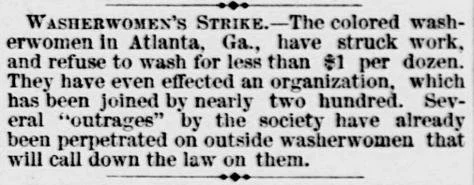
Text from the Evening Star (D.C.) on Aug 9, 1881, regarding the Atlanta strike.
African American women in Atlanta had a keen awareness of labor organizing which lead to the Washing Society official forming in July 1881, as a trade union that called a strike of their members. To keep the strike going, members met each night in a predetermined location to discuss the advantages of working together to gain full control of their own labor. By implementing a standard rate of $1.00 per pound of laundry, no laundress would be able to undercut another. Employers would be forced to adhere to the going rate. What began in July 1881 with 20 washerwomen and a few men swelled into over 3,000 striking laundresses!
The Atlanta washerwomen strike was a success. Helping them was the threat of a general strike of domestic workers. On the eve of the opening of the International Cotton Exposition in October 1881 in a city where visitors outnumbered hotel rooms, boarding houses required cooks and maids. The image that municipal promoters wanted to display to the world, that of a New South city that had moved away from its legacy of slavery, simply could not be taken seriously if not for washerwomen keeping the city’s clothes clean.
Dive in more to the details of the strike with New America.