Why Unions are Necessary: Raising Wages for Women and People of Color, Reducing the Pay Gap
Updated 5/27/26
What’s new? update on all statistics and additional pertinent ones have been included. updates made on all charts and links.
Greater pay equality exists for union workers because of the clarity that is provided by a union contract. Collective bargaining agreements apply to all workers at a job, regardless of their race or gender. Workers with unions feel more secure speaking out about pay and other workplace issues, because they know they have the power of a union.
Transparent Wage Scales: Union contracts rely on step-and-grade progression or strict classification systems that leave less room for subjective, biased salary negotiations.
Equal Opportunity Provisions: Collective bargaining agreements often include firm anti-discrimination clauses and clear, formal grievance procedures.
Benefits: Beyond base pay, union women are substantially more likely to receive employer-sponsored pensions, retirement plans, and health insurance than non-union women.
Having a union reduces the women's wage gap by nearly 40% compared to the pay gap experienced by non-union women.
Unionized women who worked full time were typically paid $1,232 per week—21% (or $216) more than women who were not in a union
Among women, Latina workers experienced particularly large financial benefits from union membership. Among full-time workers, unionized Latinas were typically paid 27% (or $222) more per week than Latina nonunion workers.
• Among full-time workers, unionized Black women were typically paid 16% (or $146) more per week than Black women nonunion workers.
• Among full-time workers, unionized Asian women were typically paid 11% (or $145) more per week than Asian women nonunion workers.
• Among full-time workers, unionized white women were typically paid 23% (or $233) more per week than white women nonunion workers
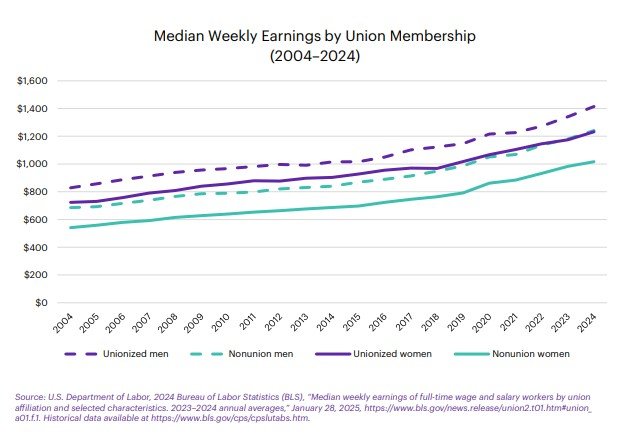
Source: U.S. Department of Labor, 2024 Bureau of Labor Statistics (BLS), “Median weekly earnings of full-time wage and salary workers by union affiliation and selected characteristics. 2023–2024 annual averages,” January 28, 2025, https://www.bls.gov/news.release/union2.t01.htm#union_ a01.f.1. Historical data available at https://www.bls.gov/cps/cpslutabs.htm.
The union advantage when it comes to wages is especially important to women. Though belonging to a union raises wages for all workers, women who are union members typically experience larger gains in their wages than men.