Workers in the United States have certain basic legal rights to safe, healthy and fair working conditions. Unfortunately, some employers may violate these fundamental rights. So what are these rights exactly?
Read More
Workers in the United States have certain basic legal rights to safe, healthy and fair working conditions. Unfortunately, some employers may violate these fundamental rights. So what are these rights exactly?
Read MoreUnion members earn better wages and benefits than workers who aren’t union members. On average, union workers’ wages are 28 percent higher than their nonunion counterparts.
While only 19 percent of nonunion workers have guaranteed pensions, fully 78 percent of union workers do.
More than 84 percent of union workers have jobs that provide health insurance benefits, but only 64 percent of nonunion workers do. Unions help employers create a more stable, productive workforce—where workers have a say in improving their jobs.
We want to alleviate any fear you might have about placing that call to your union. We are here to listen and do whatever we can to lead you in the right direction.
Read MoreEvery year more people are killed at work than in wars. Most don’t die of mystery ailments, or in tragic “accidents”. They die because an employer decided their safety just wasn’t that important a priority. Workers Memorial Day commemorates those workers.
Read MoreAt 90, Dolores Huerta is a living civil rights icon. She has spent most of her life as a political activist, fighting for better working conditions for farmworkers and the rights of the downtrodden, a firm believer in the power of political organizing to effect change.
Read MorePesotta once worked in Southern California where she had been discharged from a garment factory and blacklisted for union activity. Now Pesotta was returning at the request of garment workers to organize their industry. Within one month a new International Ladies Garment Workers Union (ILGWU) local was formed and the garment industry found itself in the middle of a bitter strike with Rose Pesotta leading the charge.
Read MoreThis labor and racial rights activist played a pivotal role in the 1943 strike at Plant No. 65 of RJ Reynolds Co., the largest tobacco manufacturing facility in the world at the time, and helped found the Local 22 of the Food, Tobacco, Agricultural and Allied Workers of America-CIO labor union.
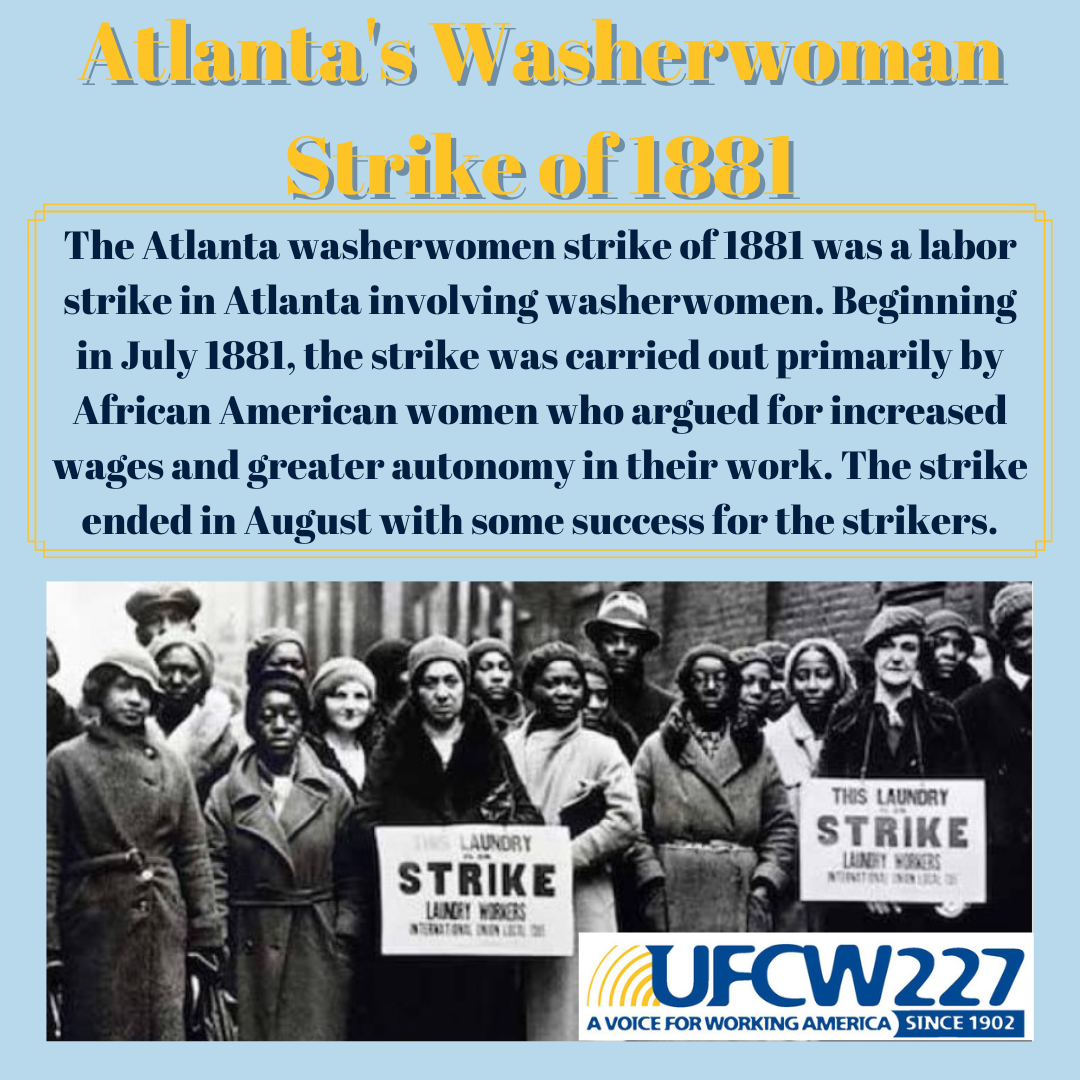
Read MoreThe Atlanta washerwomen strike of 1881 was a labor strike in Atlanta involving washerwomen. Beginning in July 1881, the strike was carried out primarily by African American women who argued for increased wages and greater autonomy in their work. The strike ended in August with some success for the strikers.
Read More“When people of color get the opportunity to be leaders, we have a responsibility to fight with everything within us to bring others along. We cannot, once we get in the door, close the door behind us. We’ve got to make darn sure that the door is not just cracked but is opened wide for others to come in.”
Read More“The colored man’s struggle until now has been for naked existence, for the right to life and liberty; with the fifteenth amendment, henceforth his struggle will be in the pursuit of happiness; in this instance; it is to turn his labor to the most effective account, to be respected therein; the most we can hope to effect in this gathering, is a crude organization; the formation of a labor bureau to send out agents, to organize throughout the land, to effect union with laborers without color.”
Read More“Those unions that enjoy the right to strike have no guarantee that sacrificing their jobs and their livelihood will result in victory but they nevertheless engage in lengthy strikes, not because they are assured of winning but because they are determined to fight.”—William Burrus, 1998
Read More